The Bottega: AI Apprentice Evaluation

THE BOTTEGA
AI Apprentice Evaluation
Transforming AI Anxiety into AI Agency Through Apprenticeship Learning
DESIGNER'S STATEMENT
The Bottega started with a simple question: what if the problem with AI adoption isn’t the technology — it’s the story we’re telling about who holds the power in the room? Every design decision in this project flows from that question. I wanted to build something that didn’t just teach AI skills, but changed how experienced professionals see their own expertise in relation to emerging tools. The Renaissance workshop is the answer I landed on. So far, it’s working.

| Overview Item | Description |
|---|---|
| Type | Virtual Instructor-Led Training (VILT) |
| Duration | 90 minutes | 10 minute introduction + Module 1: 30 minute guided practice + Module 2: 30 min team challenge + 10 minute share backs & facilitator evaluation and 10 minute debrief + Module 3: Mission and Badge Pathway Reveal |
| Audience | Higher education faculty (all disciplines) | Adaptable for corporate L&D |
| Platform | Zoom with breakout rooms + LLM: Microsoft Copilot or other + Adobe Firefly or other |
| Tools Used | PowerPoint, Microsoft Word, Midjourney, Adobe Firefly, Microsoft Copilot, Anthropic’s Claude |
| Deliverables | Facilitator guide, slide deck, Master’s Notebook (participant workbook), evaluation rubric, badge system |
| Status | Facilitator guide, slide deck, Master’s Notebook (participant workbook), evaluation rubric, badge system Faculty Version: fully developed and ready for delivery Corporate L&D: drafted and ready for finalization |
| Role | Instructional Designer, Visual Designer, Facilitator |
PROJECT OVERVIEW
The Challenge
Faculty across higher education face a genuine tension with AI adoption: they know the tools exist, but the framing they encounter most often positions AI as either a cheating risk or a job threat. Standard “how-to” training addresses the mechanical skills but leaves the underlying anxiety intact. What’s needed is an experience that repositions the faculty member’s identity — from uncertain novice to evaluating expert — before a single prompt is written.
The Solution
The Bottega draws from apprenticeship learning theory and experiential design to create a psychologically safe entry point into AI collaboration. Participants enter as master craftspeople — summoned to evaluate a powerful new apprentice — in a Renaissance Florentine bottega inspired by Leonardo da Vinci’s workshop. The historical framing isn’t decoration. It’s a deliberate design decision: placing the learner in a position of authority rather than inadequacy changes how they engage with every prompt, every output, every revision.
The session moves participants through three progressive modules using Microsoft Copilot for text generation and Adobe Firefly for image creation, with every activity producing real, course-ready teaching materials. Participants leave with completed artifacts they can use in their next class, not just conceptual understanding of what AI can do.
Impact / Outcomes
- Produces 2–3 AI-assisted, course-ready artifacts per participant during the session itself
- Reframes AI from threat to collaborative tool through identity-centered design
- Embeds the OPEN ethical framework (Openness, Precision, Ethical Use, Knowledge-Building) as a practitioner habit, not a compliance checkbox
- Two-tier badge system (Level 1: session completion, Level 2: independent post-session submission) creates continued engagement beyond the 90 minutes
- Complete facilitator package enables institutional replication without the original designer
- Scalable across disciplines — examples span humanities, STEM, and professional programs
BADGES OF THE BOTTEGA
Earn Your Commission
Every apprentice who enters the workshop has the chance to earn their commission. Complete the challenges. Prove your craft. Claim your badge.
Participant - Apprentice
You showed up. You picked up the tools. In the Bottega tradition, that's where every master begins — not with expertise, but with courage and curiosity. Welcome to the workshop.
AI Foundations -Journeyman of the Studio
You didn't just observe — you practiced. You completed the Studio Challenge and demonstrated that AI isn't something that happens to you. You make it work for you.
AI Foundations - Studio Champion
Your studio brought it. Your team collaborated, debated, and delivered something worth hanging on the wall. This badge marks the moment your collective expertise met its match — and won.
AI Master Craftsperson
Rare. Earned. Undeniable. The Master Craftsperson badge is awarded to those who demonstrated not just skill, but vision — the ability to see AI as a collaborator, not a shortcut. Da Vinci would approve.
DESIGN DECISIONS
Decision 1: The Master /Apprentice Inversion
The most significant design decision in The Bottega was structural: flipping who holds the expertise. In most AI training, the human is positioned as the learner and the AI as the capable system. This framing activates impostor syndrome in experienced professionals, particularly those who have spent decades developing deep subject-matter expertise. By positioning AI as the apprentice being evaluated by master craftspeople, the design makes faculty expertise the irreplaceable variable. The AI cannot do this work without the master’s direction, taste, and judgment. This isn’t just motivational framing — it’s an accurate representation of how effective AI collaboration actually works. The metaphor teaches the skill.
Decision 2: Authentic Output From Minute One
Participants begin producing real work within the first module. There is no extended orientation, no abstract explanation of AI capabilities, no demo-before-practice sequence. The deliberate choice to start with creation — and let reflection emerge from the experience — is grounded in Kolb’s experiential learning cycle and the performance focus of modern instructional design. Theory that can’t be immediately applied tends not to transfer. Work product that exists at the end of training tends to get used.
Decision 3: Immersive Aesthetic As Pedagogical Tool
The Renaissance workshop imagery, period language, and character-consistent facilitator scripting serve a specific function: they create psychological distance from the modern workplace anxiety that makes AI adoption difficult. A faculty member sitting in their home office, worried about institutional AI policy and student cheating, is cognitively overloaded before the first prompt. That same person, inhabiting the role of a Renaissance master evaluating an unfamiliar tool, is curious, authoritative, and safe to experiment. The aesthetic is the intervention.
Decision 4: Built To Be Handed Off
Scalability was a design requirement from the start. The facilitator guide includes character-consistent language substitutions, troubleshooting scenarios, and a complete timing map. Any trained facilitator can deliver this session without the original designer in the room — which is what makes it an institutional asset rather than a one-person show.
WHAT WAS BUILT
Full Deliverables Package
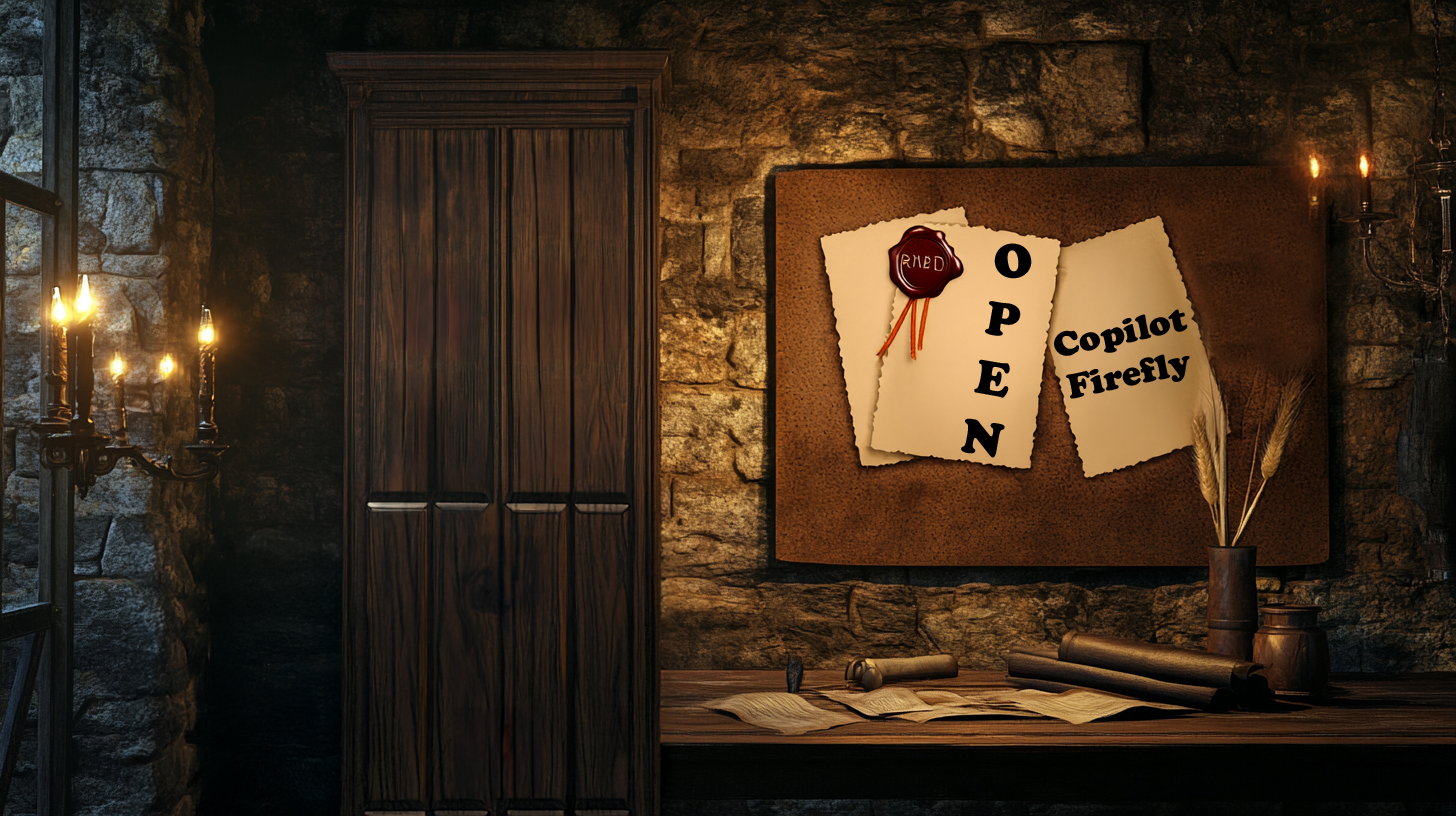
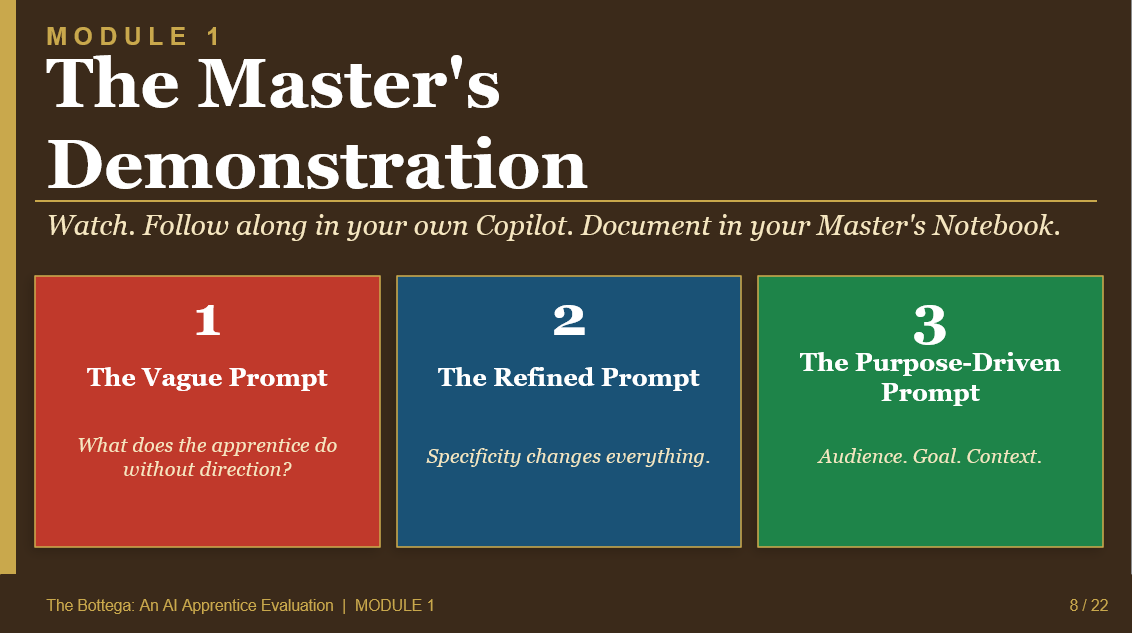
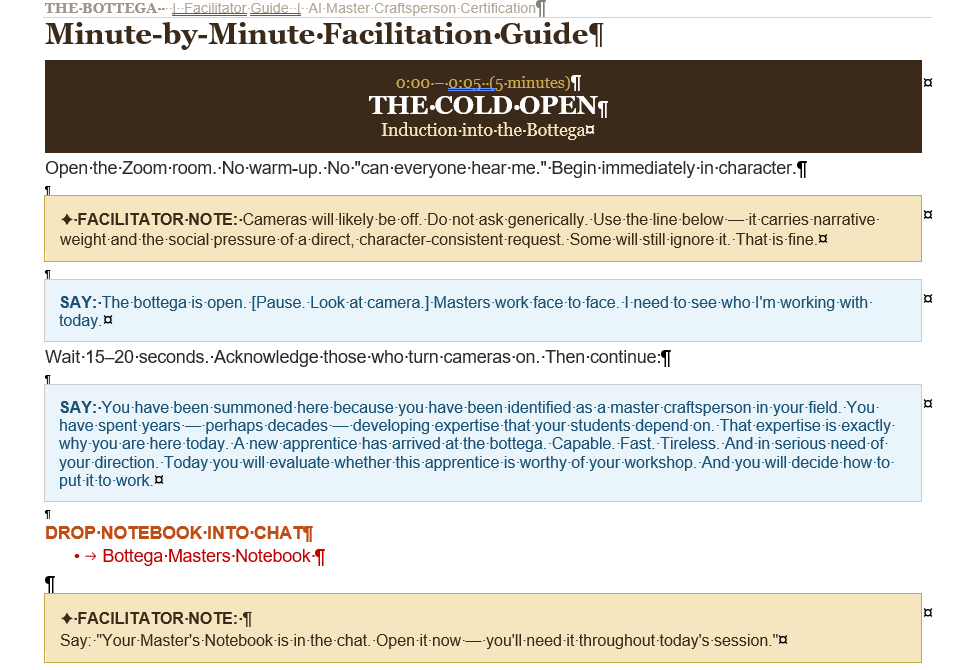
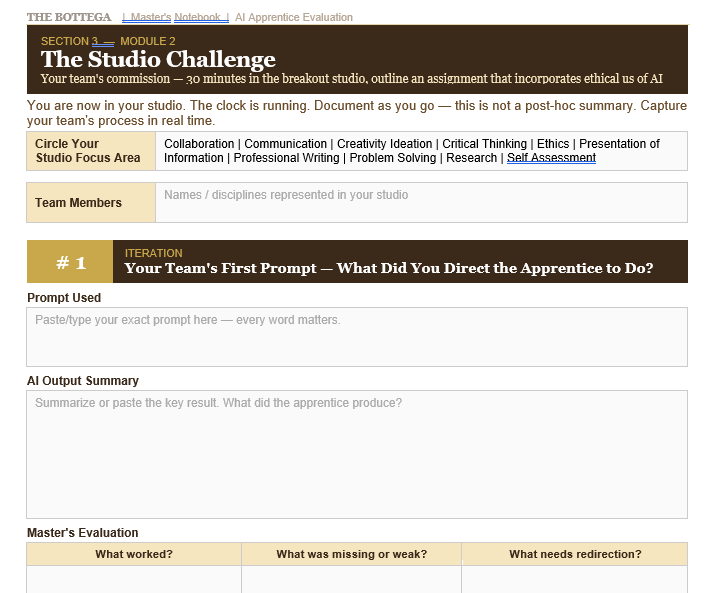
Facilitator Guide (complete with timing, facilitator scripts, character-consistent language substitution table, troubleshooting scenarios, and pre-session setup checklist)
PowerPoint Slide Deck (90-minute fully designed deck with Renaissance aesthetic, immersive imagery, and all activity scaffolding)
Master’s Notebook (participant workbook used across all three modules — prompt journal, iteration tracking, final assignment template, and reflection prompts)
Evaluation Rubric (rubric-based assessment of both artifact quality and AI collaboration process, supporting Level 1 and Level 2 badge criteria)
Priming Email (pre-session participant communication — subject line: “You’ve been summoned to the bottega.”)
Badge System (two-tier digital badge structure with defined criteria for session completion and independent post-session submission)
THE OPEN FRAMEWORK
ETHICAL AI COLLABORATION
Woven throughout The Bottega is the OPEN framework for ethical AI collaboration: Openness to experimentation, Precision in prompting, Ethical use of AI-generated content, and Knowledge-building through reflection. This isn’t delivered as a compliance module or a slide of bullet points — it’s embedded in the structure of every activity. Participants practice ethical AI collaboration; they don’t just hear about it.
The Master’s Notebook documents each prompt iteration, the participant’s evaluation of the AI output, and the revision decision — creating a visible record of the prompt-revise-evaluate cycle that is itself the evidence of ethical, intentional AI use.
AUDIENCE & FUTURE VERSIONS
Current Version
Instructional Designers, Curriculum Designers, Faculty, Instructors
Designed for higher education faculty across all disciplines, this format stands strong for all levels and types of curriculum design. The session uses assignment design as the working context because it produces immediately usable artifacts and maps directly to professional practice. Examples in the session span humanities, STEM, and professional programs.
Adaptable for
Corporate L&D professionals building AI-assisted training content
Instructional designers developing AI literacy within their own teams
K–12 educators (with age-appropriate content modifications)
Any professional audience needing hands-on AI skill development in a psychologically safe environment.
In Development
A second version of The Bottega is planned that removes the assignment-design focus in favor of a broader content-creation framework — making it directly applicable to corporate training, consulting, and cross-industry professional development contexts. The apprenticeship frame, OPEN ethical framework, and badge system will transfer intact.
TECHNICAL SPECIFICATIONS
| Overview Item | Description |
|---|---|
| Duration | 90 minutes (VILT) | Adaptable for asynchronous delivery |
| Capacity | 15–25 participants (optimal for peer interaction and facilitator support) |
| Platform | Zoom with breakout room capability |
| AI Tools | LLM text/generation + image generation |
| Assessment | Rubric-based evaluation of created artifacts + self-reported confidence measures + badge criteria |
| ID Framework | SAM | Apprenticeship learning model | Experiential learning cycle (Kolb) | Brain-centric design |
| Design Tools | Midjourney/Firefly (environmental imagery), PowerPoint, Microsoft Word |
| Experiential Learning (LXD) | Two-tier badge system with defined criteria |