The Taxonomy Gym
THE TAXONOMY GYM
A Place For Cognitive Curriculum Training
A Practice Suite for Cognitive Learning Scaffolding
DESIGNER’S STATEMENT
Faculty development content about Bloom’s Taxonomy has a problem: it’s usually delivered the same way every time — a diagram, a list of verbs, a chart. Informative, maybe. Memorable, rarely. The irony of teaching a framework about cognitive engagement through the least cognitively engaging methods possible wasn’t lost on me.
The Taxonomy Gym exists because the research is clear: we remember what we do, not what we read. Multiple exposures in different formats, low-stakes practice, tool interaction, and just enough challenge to require actual thinking — that’s the combination that moves new learning into long-term memory. So instead of another handout about Bloom’s Taxonomy, I built a suite of short activities that use Bloom’s Taxonomy to teach it.
The Gym is organized by cognitive level — you work at Level 1 before you work at Level 2, exactly the way the taxonomy itself works. Currently open: Levels 1 and 2, each with a dedicated game and integrated job aid. Levels 3 and above are in development. Every addition follows the same design principle: practice the framework by working inside it, not just reading about it.

SUITE OVERVIEW
The Taxonomy Gym is a collection of short, replayable practice activities organized by Bloom’s cognitive level. Each activity is designed around one core idea from the learning science: we retain what we actively do.
The two current games share the same Bloom’s Taxonomy job aid — a downloadable Excel spreadsheet of measurable verbs organized by cognitive level. Using it demonstrates Level 2 understanding. Navigating without it demonstrates Level 3 application. Either way, you’re practicing.
Both games are SCORM-deployable to Canvas LMS and designed to be replayed. The first playthrough builds familiarity. The second builds confidence. The third builds fluency. That’s the gym.
| Overview Item | Description |
|---|---|
| Type | Gamified Practice Activity Suite |
| Current Levels | Level 1 (Recall) and Level 2 (Understanding) |
| Audience | Faculty across disciplines; instructional designers; anyone learning Bloom’s Taxonomy |
| Platform | Canvas LMS + Articulate Storyline (SCORM) |
| Tools Used | Articulate Storyline 360, Canvas LMS, Excel (Job Aid) |
| Deliverables | Two standalone Storyline games, downloadable job aid spreadsheet, Canvas-deployable SCORM packages |
| Status | Active — Levels 1 & 2 deployed; upper levels in development |
| Role | Instructional Designer, eLearning Developer, Content Developer |
THE SCIENCE BEHIND THE GYM
Before you train, here’s why this approach works.
Bloom’s Taxonomy describes how learning deepens as cognitive demand increases. Every new concept enters at Level 1 — recognition and recall. As we engage with it in different ways, understanding develops and transfer to long-term memory begins. We cannot skip levels: applying a concept (Level 3) requires being able to recall it (Level 1) and understand it (Level 2) first.
The research on long-term memory transfer is equally clear: spaced repetition and multiple low-effort exposures outperform a single high-effort encounter every time. A game played three times across a week does more cognitive work than a worksheet completed once. That’s not a game design philosophy — it’s neuroscience.
Both Taxonomy Gym activities are short by design. Play one in five minutes, replay it in three. The goal isn’t comprehensive assessment — it’s building the kind of familiarity with Bloom’s Taxonomy that makes applying it to curriculum design feel natural rather than forced.
LEVEL 1: Recall
Measurable Maze — Can You Find the Verbs?
Before you can use Bloom’s Taxonomy to write learning objectives, you need to recognize measurable verbs when you see them. That’s Level 1 work — recall and recognition — and it’s what Measurable Maze is built for.
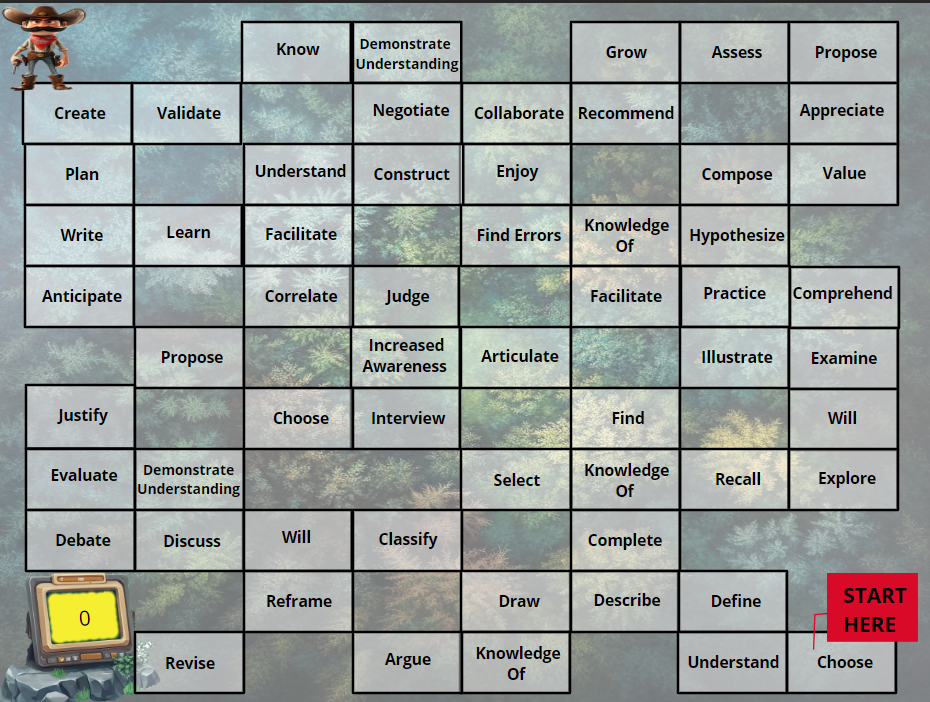
How it works: Navigate a tile grid from the lower right to the upper left by clicking on measurable verbs. Correct tiles turn green and add a point to your score. Incorrect tiles turn red and deduct a point. You need 14 points to escape the maze.
The Bloom’s Taxonomy job aid — a downloadable Excel spreadsheet organized by cognitive level — is available for reference throughout. Using it is encouraged, especially on your first run. By your third run, you may not need it anymore. That progression from reference-dependent to independent is exactly how tool adoption is supposed to work.
What you’re practicing:
- Recognizing measurable verbs on sight (Level 1 — Recall)
- Distinguishing measurable from non-measurable verbs (Level 2 — Understanding)
- Navigating the job aid spreadsheet under light time pressure (Level 3 — Apply, if you use it)
Key Features: Tile navigation | Point-based scoring | Green/red visual feedback | Downloadable job aid integration | Replayable design | SCORM deployment to Canvas

LEVEL 2: Understanding
Cognitive Conundrum — Where Does It Belong?
Recognizing a measurable verb is one skill. Knowing which cognitive level it belongs to is another. Cognitive Conundrum targets that second skill — classification and understanding of the taxonomy structure itself.
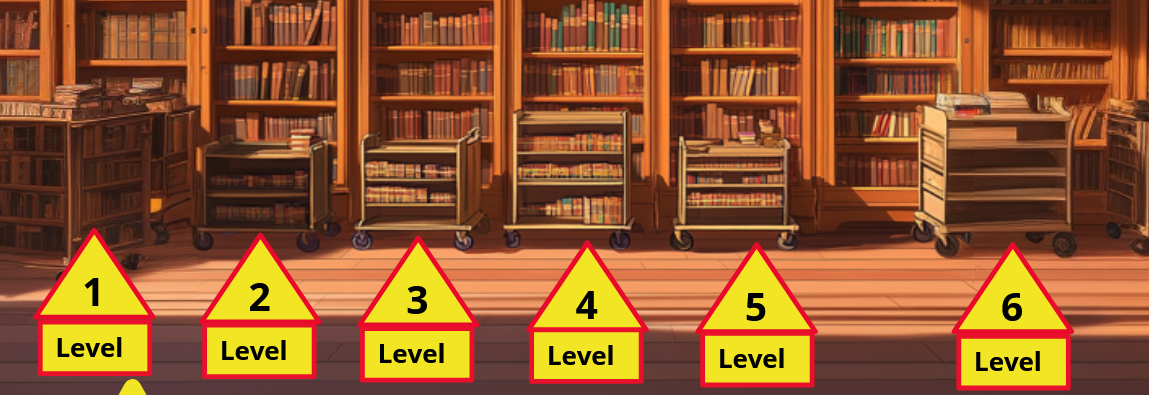
How it works: You are presented with 12 books, each titled with a concept from Bloom’s Taxonomy. Drag each book to the library cart representing the correct cognitive level — six carts, six levels, each marked with a triangle indicator and level name. Correct placements stay on the cart and increase your score. Incorrect placements return the book to the center for another attempt. Timed and scored for replayability and light competitive engagement.
What you’re practicing:
- Recalling the six cognitive levels and their order (Level 1 — Recall)
- Understanding the distinctions between levels (Level 2 — Understanding)
- Classifying concepts by cognitive level without prompting (Level 3 — Apply, if you work without the job aid)
Key Features: Drag-and-drop interaction | Score tracking | Timed challenge | Six-level classification | Job aid integration | Replayable design | SCORM deployment to Canvas
DESIGN DECISIONS
Decision 1: Organize by Level, Not by Game
The page structure mirrors the taxonomy itself — you encounter Level 1 content before Level 2 content, exactly the way Bloom’s says learning should work. This wasn’t just a navigation choice; it was a pedagogical one. A faculty member arriving at this page experiences the framework before they finish reading about it.
Decision 2: Make the Job Aid Part of Practice
The Bloom’s verb spreadsheet is a genuinely useful tool that most faculty don’t use consistently because they’ve never had a real reason to navigate it under any kind of time pressure. Both games create that pressure — lightly, without stakes — by putting users in situations where having the job aid open is genuinely helpful. The goal is adoption through repetition, not compliance through requirement.
Decision 3: Design for Replayability, Not Completion
Both games are explicitly designed to be replayed. Scores, timers, and replay prompts aren’t just engagement mechanics — they’re the pedagogical point. Spaced repetition across multiple short sessions is more effective for long-term retention than a single longer encounter. A game someone plays three times builds more durable knowledge than a worksheet completed once and forgotten.
Decision 4: Let the Activity Model the Principles
The Taxonomy Gym’s most important design constraint: can the activity itself demonstrate the theory it’s teaching? Both games engage users at Bloom’s Levels 1, 2, and 3 — exactly the levels described in the framing content. Faculty who complete either game have just experienced the taxonomy from the inside, not just read about it from the outside. That alignment between content and method is what makes the learning stick.
Decision 5: Build a Suite, Not a Standalone
Two games covering different skills at overlapping levels is more powerful than one game covering everything shallowly. The suite structure signals intentional design — this is a curated practice environment, not a one-off activity. It also creates a natural expansion path: as upper-level activities are added, the Gym grows without any existing content becoming obsolete.
COMING TO THE GYM
Level 3: Application Wing — Activities where faculty apply the taxonomy to real curriculum decisions rather than sorting abstract concepts. Scenario-based design, objective writing challenges, activity classification against real course content.
Upper Levels Studio (Levels 4–6) — Analysis, Evaluation, and Creation require different interaction design — less sorting and navigation, more judgment calls, peer comparison, and reflective practice. Higher cognitive demand, higher design challenge. Coming.
Alignment Studio — The bridge between knowing the levels and using them in curriculum design. A guided tool for connecting learning objectives to activities and assessments across the full taxonomy. The practical payoff for everything practiced in the Gym.
The framework doesn’t stop at Level 2. Neither does the Gym
TECHNICAL SPECIFICATIONS
| Overview Item | Description |
|---|---|
| Authoring Tool | Articulate Storyline 360 |
| Interaction Types | Tile click/navigation (Measurable Maze), Drag-and-drop (Cognitive Conundrum) |
| Scoring | Variable-based point tracking in both games |
| Feedback | Immediate visual feedback — color-change tiles, score updates, cart placement confirmation |
| SCORM | Both games deployed to Canvas LMS for completion tracking |
| Job Aid | Downloadable Bloom’s Taxonomy verb spreadsheet (Excel) — shared across both games |
| Replayability | Explicit replay prompts in both games; no completion lock |
| ID Framework | Bloom’s Taxonomy (Anderson & Krathwohl revision), spaced repetition, retrieval practice |
| Audience | Faculty across disciplines; no prerequisite knowledge required |
| Status | Levels 1 & 2 active; upper levels in development |