It’s been a bit more hectic than usual, and my blog has been severely rejected. That’s not to say that I haven’t been busy, I have, however postings have been in the form of learning content amidst work and life rather than the traditional blog post that finds it’s way to the forefront. What I’ve been up to, well you can check out my ever evolving basecamp portfolio to find out, but what’s on all of our minds now is “the new norm”, whatever that means.
Here we are in world where “social distancing”, “online meetings”, “new technology”, and “asynchronous and synchronous online interactions” are becoming our new norm. For how long, who knows. In the midst of it all one can’t help but wonder if an external source is pushing us in a direction we should already have been prepared to go on our own.
I saw online learning, meetings, interactions, and work as the wave of the future a number of years ago. That year for us came when my mid-high school son had a gun pulled on him just off of the high school campus, but no-one in any level of authority saw it, and he said he wasn’t going back to school. So what did we do? We sought other learning opportunities for him. That meant, a technical school for a 2 year culinary degree, early college, and online school to carry him through is last two years of high school. His brother enrolled in early college and online school that same year and in the end what I saw was a couple of brothers who were learning things I thought they should have been learning all along, not only at home, but in school.
They learned finance and economics that applied to them instead of the high school “academics” that really wouldn’t lead them into a sustainable life. They left behind the coursework that might help them get into the best colleges, which they both did anyway, and the academics that weren’t giving them what they needed to navigate life. Don’t get me wrong, I’m a learner at heart, an academic who will always love to learn and grow, but I think pubic education in K-12 should be about teaching students what they need to know to make it in this world, expanding horizons, created well rounded humans, the focus should not be test scores and entrance exams. When they are mature enough to choose a path, then pick up the gauntlet of teaching and learning things like calculus, anatomy, and other material that pertains to their chosen path, if those subjects are part of the path they wish to pursue. With the availability of online learning today, it’s time we recognized that sky high student loans are not the choice of many young learners today who can and will find a different way to learn and navigate their futures. There are so many options in this new world it can be daunting for those who didn’t grow up in the midst of it, but change is in the wind.
So here we are, pushed into online learning in many ways. Pushed into it through a virus around us that still promises to reveal what the final impact will be. The question is, a virus pushed us in that direction, but were we ready? I don’t know that we were. As instructors, teachers, and professors amongst others, strive to find an effective way to teach online… I can only hope that they turn to the research and the people who have invested their time in trying to learn what makes for effective online teaching. It surely is not just turning on Zoom and recording a lecture from a remote place, a lecture that may be viewed live, or recorded so students can turn to it as they have time while they navigate these major changes themselves.
Yes, Zoom, Skype and the like are great tools when used effectively, and for now they are the best way to get through the end of this year while keeping our students on track with their education. My hope and my plea is that instructors look for the best ways to set up their courses, that they either learn about engaging students on line, or they turn to someone to help them pick up the mantel and prepare an online course to either roll out for the next semester, or to hold on the sidelines to pull in at some point in the future so they can effectively stand in the gap should something like COVID-19 happen in the future.
Outside of the existing learning technology and tech that continues to be developed, one of the things I find most fascinating within education, learning, and instructional design, is recognition of and use of, the most direct path to facilitate learner understanding and the key to facilitating transfer to long term memory. A podcast I listened to today added another “ah ha” moment to my design repertoire, as I look back I feel like I have seen this in action, it registers as relevant, believable, and real world to me. I thought I’d share some of the information contained within the podcast with my fellow graduate learners and others who have a passion for understanding human learning, and those who seek to understand learning at its core.
Connie Malamed, a favorite learning design podcaster of mine, recently interviewed John Sweller, an Emeritus Professor at the University of South Wales Sydney. Their discussion centered around cognitive load and effectively reaching the person you are trying to transfer information to. I have to say that long before she mentioned it at the end of the podcast, I had thought to myself ‘wow this is powerful stuff from a teaching, learning, and design perspective.’ So although I’ll shed some light on the conversation here I’ll also note that you’re missing out if you don’t dial it up and listen in to the E Learning Coach, episode 55, located here. Whether you’re an instructor, a designer, parent, coach or any one tasked with communicating information, even in a presentation, this definitely has something for you so listen up!
The interview centers around cognitive load and transfer to long-term memory. Have you ever found yourself in a class or presentation and wondered, why am I just not getting this… why it is not sinking in… why can’t I remember what was on the Power Point a few slides ago that seemed so important. If you’ve never been there you’re a lucky one of the few, if you have, the information below might prompt some tips and tricks that will save you when the person presenting is blissfully unaware as to why the information they’re flooding you with isn’t sticking in your mind. And if you are an instructor, instructional designer, or presenter, this is gold. Here, you will find some of the high points, but ultimately my advice is go listen, go read, go educate yourself. Then evaluate and see if it rings true for you.
Connie introduces the podcast by stating that learning professionals and product designer’s need to understand how people learn to be most effective. Unfortunately many people don’t clearly understand the way we learn, knowledge that contains key information which, when used, gives us the best chance of leveraging it to assist us as we target the goal of facilitating learning and transfer of information to long-term memory. While explaining key points within his theory of cognitive load, Professor Sweller introduces the concepts of primary and secondary knowledge as the underlying keys to facilitating learning and retention.
He explains primary knowledge as knowledge we naturally acquire without an instructor, like learning our mother tongue from those around us as a young child. This information can be tremendously complex, however we acquire it relatively easily. Secondary knowledge is the stuff that we learn in a more formal setting, like school, where someone is transferring the information to us with the intent to teach us something we are either interested in, or something that will serve us well in the future, like reading, arithmetic, etc. Although we are quite capable of learning secondary knowledge it requires a conscious learning process and the information is often more difficult to process, for example learning to read and write.
His reflections in the discussion focus on secondary knowledge and our educational system, which was constructed as the primary means by which secondary knowledge is transferred to students in an effort to educate them. Instructional design also falls into the category of transferring secondary knowledge through instruction. He would argue that this process of knowledge transfer is most effective when the limitations of working memory, transfer to long-term memory, and the effect of cognitive load are taken into account. This requires an understanding of the framework of how we learn, or as Sweller calls it our cognitive architecture. He goes on to define working memory as the things we are conscious of as we process information. Working memory has a couple of aspects, its capacity and the duration of time that we are able to hold working information in our memories as we process.
He continues by noting that 2-4 elements at a time is all of
the information we are capable of dealing with when learning something new,
processing concepts, or solving a problem.
To compound complexity as we consider instructional methods, design, and
content, we also need to take into account the fact that we are only able to
hold information in working memory for about 20 seconds. Very appropriately he asks, “how do we
function under those circumstances?” This is
where long-term memory comes to the rescue. Thankfully it has no known
limits of capacity or duration, therefore if we can facilitate the transfer of
new information to long-term memory it can then easily be drawn upon by the
learner at any point, and without effort while not imposing on the limitations
of working memory.
Working memory is limited when dealing with novel information, it’s effectively unlimited when dealing with processed, stored information that we get from long-term memory. That is critical because it tells us why we are engaging in instruction. It tells us we engage in instruction in order to get information into long-term memory.
John Sweller
At this point I was thinking back to Julie Dirksen’s “Design for How People Learn”, wherein she references introducing new knowledge in a number of different ways to create a space where people can relate the information to an experience, and/or, process it in a number of different ways. This gives them multiple pathways to process and classify information in order to facilitate transfer to long-term memory and thereby provides the best opportunity for the learner to most effectively recall it when needed. That in turn took me back to the words of one of my piano teacher’s who would encourage me to read the music, memorize the music, play with the metronome, play with my eyes closed! Whether she knew it or not she was creating multiple paths for transfer to long-term memory and it worked! Now I can add ‘play with the recorded CD’ to the list of practice tools I suggest to my students.
The discussion continues with the definition of cognitive load as that thing imposed on working memory when we are asked to process multiple elements of novel information, or information that is more complex and requires thinking about multiple things at once. However armed with an understanding of the impact of new information on working memory the instructor or designer can account for these factors and introduce material in a way that is more easily digested while decreasing cognitive load and facilitating transfer to long-term memory. Ultimately it’s about finding a path from introduction and attention getting, to exposure in various ways in an effort to help facilitate understanding and transfer to long-term memory. As Sweller references, there’s something to that old saying that the more you know, the easier it is to learn new things. Since there is no impact on the limited capacity of working memory when drawing from long-term memory, knowledge stored in long-term memory lessens cognitive load and allows the learner to place more emphasis on understanding and shelving the new concepts while facilitating the transfer of new information to long-term memory.
How do you prompt the “ah ha” moment, make the light bulb come on, and help facilitate the learner with transfer to long-term memory? As you map your learning plan or design keep these things in mind:
Working memory can handle short simple facts, of up to 7 plus or minus 1, while memorizing rotely.
The limitations of short-term memory is limited when it comes to new/complex information, 2-4 pieces of new is the maximum
The value of presenting information with the intent to offer multiple paths to exposure, understanding and shelving of information to facilitate transfer to long-term memory.
As you approach your next challenge to communicate new information are you ready to embrace and implement the keys to reducing cognitive load and facilitating transfer to long-term memory? If so, I challenge you to engage!
Questioning Dispositions, Qualifying Inquiries, & Quantifying Decisions
Simply Put – Where To Go From Here…
In Big Thinkers, John Seely Brown points out the seemingly obvious, that change is an everyday word now. Students growing up and preparing to enter the workforce will need to have a learner’s mentality which means staying engaged with the new and expecting change rather than being hesitant or surprised when it happens. He suggests that the questioning disposition exists in the video gaming world, so how do we bring that to education. Game players embrace change, they expect it, I think they would be surprised, or bored, if they didn’t see it. Maybe it is this mentality that keeps me so intrigued by the potential behind a gaming scenario to support and further learning through engagement, practice and repetition.
As we look to the second half of the semester in INTE ,Digital Storytelling I’d honestly like to design a game. I have no idea what I am getting into here, that’s scary, but I think taking a shot at it would be a lot of fun. Ultimately a video game but that’s a stretch at this point since I’m not a programmer, but something that could be incorporated into learning. I keep coming back to either music or a game that really drives home the potential impact of gaming in education. If not music then something grad students could engage in to immerse themselves with something they know little about, to give them a chance to experience what their students would through use of a gamified lesson or classroom, something to serve as an encouragement to jump in and follow suit.
Wow, that being said I’m ready to retract it all since it seems like a huge undertaking, but to push the boundaries one would have to start somewhere and in discussions, and even the unconference, I feel like I’m hearing that’s the scariest part for most educators and likely why they don’t jump in. To me it’s a challenge calling but to be realistic, maybe just the design? How would I build it out if I could? I’m not sure though, I feel like maybe I would be in way over my head here but it’s such an intriguing concept.
Non- the-less for me choosing between more reading and theory I would have to go with more doing! I think we can read and analyze all day but it’s where you have to put your mind where your creation is that the real learning occurs. With permission to fail I think that having to jump in and have a go at it really gives you another perspective. Hopefully it’s a surprised, I really can do this, paradigm shifting mentality at the end. Either way I think it puts you in a different headspace and in the process I’d be shocked if one didn’t have to do more research while figuring it all out on your own as well! Wow, did I just say that?
The first thing that really caught my attention was the video of his son as he was learning to go down stairs. Michael had taken video, after video, of this learning process. As the video played in the background he noted that as children we think we should be able to do something so we just keep trying, failing, and trying again until we get it. We might look to our parents for approval but we’re ok with failing, we just get back up and go at it again, each time learning something new! It is the intrinsic motivation to be able to do “this thing” that keeps us coming back to it until we can do it and being in the midst of doing it is the best way to learn. Games offer that same opportunity to learn as we play without fear of failing, to keep trying until we master something, and whether it’s a video game, a board game, or any other kind of game, there’s a natural pull that brings us back until we win, or master whatever it is that keeps drawing us back. I was introduced to these concepts when I first started really thinking about designing learning, but this semester my eyes have been opened to some really neat things. It’s interesting that although they were really there all the time, it’s something that’s right in front of your face but until someone points it out, it’s not always easy to see. This story is all about the unconference I was at yesterday, seeing others react to aesthetic learning, and the tie to games and what a valuable tool they are in creating those aesthetic, memorable, experiential, learning environments.
I was introduced to thinQstudio through my Digital Storytelling class, part of the INTE program at the University of Colorado Denver. The thinQstudio is a group of education innovators who get together to look for, brainstorm, share, and encourage others to pull in new concepts in education to push it to a new level. Yesterday I attended the rethinq101 conference, well not really because it was an ‘unconference’. A space where attendees were asked to suggest and select topics to think about, discuss and brainstorm pieces of the future of education. To set the tone and get the rolling we started off with a look at the innovative approach the keynote speaker, Michael Wesch, has adopted for the classes he teaches. The story above, of his reflections on watching his son, sparked a change in his approach to teaching. If you haven’t heard of Michael you really need to look into some of his projects, I’ve left you a list below. In fact, what he has to say is so inspiring that at least one of the people I spoke to had heard him speak before and shared that he was the reason they had decided to come.
Learning in an immersive environment holds so many keys to motivation and engagement. Given permission to fail is, I believe, the most fertile learning environment that can be found. As Michael talked a little about learning a new language I smiled and thought back to when I was twelve, in Norway, and going to school there, immersed in a language and culture I knew nothing about. He suggested that we can agree that immersion is the best way to learn a language, just get in and do it. Yes, it’s an experience, albeit sometimes challenging, but when we keep at it we come out on the other side and success. And for me the end the struggle was totally worth it and I hardly remember the rough days… wait were there any? So why do we struggle with the concept of immersive/experiential learning in other areas? This was actually something I was asking myself just last week when writing for a class.
Now that the world is changing, seemingly at the speed of sound, we need to be creating a passion for learning, setting the stage for the expectation of lifelong learning, and finding ways to foster engagement through tapping into student passion while pulling them into new types of learning environments that stretch them and plant the seeds to encourage them to keep coming back, even after they’ve mastered what they initially set out to do.
There are so many tools to do this, however we need to disrupt our ways of thinking and start moving in new directions, then watch as the world changes with us. I know it can be done, we just need a few brave souls to step out lead the charge. Are you one of them?
The unconference, was really about tapping into the things that attendees wanted to discuss, things that are hot topics in education today, things that are on their minds and prime for use in new an novel ways. Some examples might include:
Augmented and Virtual Reality
The Use of Digital Tools
Student and Instructor Agency
Mobile Learning
Where do we start, how do we do this?
And more…..
At the end a panel was asked where they thought they’d see education in the future? Personalized learning, where the students drive what they want to learn and how, was mentioned as well as a scenario where robots teach the subject matter to students so academics could get back to what academia really used to be, study, contemplation, research, etc. Other topics like a switch to no grades to really open up possibility, and finding ways to restructure so the learning was the focus, thereby eliminating questions like “will this be on the test?” Doing this opens the door to create a quest for discovery and knowledge.
If you haven’t been to a thinkQstudio event and you’re in the area, you need to check it out! As Michael put it, he envies what we have here and wants to know where this group is headed, because he wants to head there to! If you’re ready to change your “classroom” and give students an experience they will always remember, check out some of his projects below and start brainstorming what you might do differently to tap student’s passions and engage them in aesthetic learning.
Link’s to some fo Michael Wesch’s work.
Baby GeorgeA Vision of StudentsThe SleeperANTH101.comTo Live In This WorldMarshmallow WarsBuilding The Troost Wall
Mediascape: Games & Digital Stories In A Digital World
We bumped into a number concepts over the past few weeks
games, the introduction of a class project focused on a potential deep dive
into a story-world, and where the digital world has taken us as a society and
the concept of digital storytelling. It was
a unit of thought provoking fun to be enjoyed from start to finish as it
stretched my knowledge and vision in many ways!
I have my eyes on building a very complex music theory game to take the dull drum out of learning music theory for kids in K-12 who are taking private music lessons, so seeing where games can go even in their simplest form was interesting! Educational games that really work is what drew me to this program so I got a kick out of seeing and interacting with the games, and I did post a couple of social media Tweets on them which is pretty big for me. The more I read, see, and play the more I see how much there is to learn. Resonant Games has recently captured my attention, it really pulls you into what they’ve found to be effective in the gaming world!
The Story-World project was launched and the idea of
creating an alternate reality is always intriguing, yet challenging. The concept totally captured my attention,
although I wasn’t sure how much of an idea pitch was wanted in week one. So I threw some ideas out there, then the
next week voted on the options, I have to admit I was a bit lost with where we
were heading with this project. Well at
least until this week, week seven when we were assigned to teams to pitch a full
blown concept. Now I’m waiting to see
what comes next!
Digital storytelling was next on the list. This was a concept new to me when it was introduced in week five, however it is where my choice for my second challenge stemmed from. I found the link between stories as they were told at the dawn of time, and even more recently in New Guinea, a really interesting concept when bumped up against the opportunity we have with today’s digital storytelling opportunity. The Web 2.0 offers a powerful tool from both a creative and a logical, problem solving aspect. I can’t wait to see if we have the gumption to latch on to it, and if so where we go with it as a society.
The reflection game was an interesting way to look back on
the first few weeks’ and one I tucked that one away for future use, thanks for
sharing it! I’m using Twine as a tool
to write an interactive quiz story for new staff in conjunction with a required
review of the safety policy at the Distribution Center Warehouse!
I could totally connect with your stream of consciousness
reflection, for me it’s no longer about a spouse and kids but working, teaching
piano, theory and taking classes. But,
if I wasn’t busy I’d be bored, although sometimes I think that’s not quite a
good thing. Focus and things pulling me
off on a tangent as they capture my attention, as highlighted this week as
well, have never been an issue for me, enough time in the day always has! I do marvel at how the world has changed
since my childhood and proximity has taken on a whole new meaning. I don’t think proximity has anything to do
with a physical location anymore, but rather a mental proximity as we become
more comfortable being spread across states, nations, & countries and are
still able to stay in touch and close to others if we so choose.
For me it was another few weeks of “eyes open” and looking into new possibilities, the best part is a lot happened! Here in this environment I get to dig in as well which is the best part. Stretching my vision with new knowledge, then getting to put I into play with coming up with a new challenge to work on and considering the story-world group project was likely the highlight of this unit for me.
From A Caveman’s Tales to Collaborated Digital Stories
Digital stories have begun to come to life with the dawn of the Web 2.0 where people are able to post thoughts and content to websites and social media. This opens the door for a return to the days where stories were a living breathing part of society. People would interject into them, morph and change them based on their experiences and interpretations.
This story was created for a project in conjunction with a class assignment for CU Denver’s INTE 5340, a Digital Storytelling course within an Information Technology Master’s degree program. It tells the story of a character I have chosen to call “Professor Story” as he travels through time and the evolutions of stories as we know it. His story comes to life through Grug, the father figure in the Dreamworks Animation movie production The Croods, which showcases a caveman’s challenges with accepting change and adapting to world that was changing around him.
To view the story full screen please use this link.
Tasked with the group project of proposing a class project I drafted a dystopian, what if story based on life after an EMP.
As a team of three we communicated via email, gathering thoughts on a Padlet, and transferred our final product to a Webpage as the shell of what the final project would look like if the class were to pursue buildout.
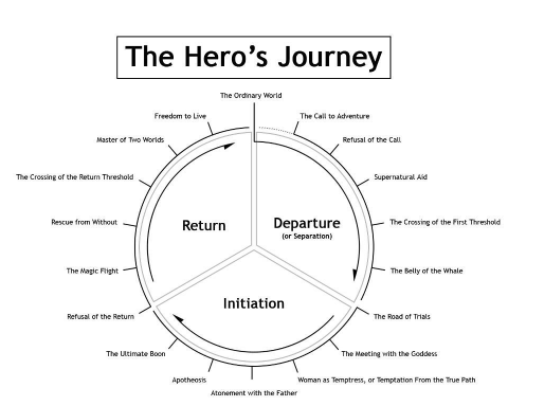
As we delved into the concept of the Hero’s Journey in unit one of Digital Storytelling I was ecstatic to have a path to follow. A story-circle, a template for understanding, planning, and creating an engaging story that draws people in. The thought of creating the sticky content that Chip and Dan Heath talk about in Making Your Presentation Stick isn’t quite as daunting with this tool in my tool belt. I did say not quite as daunting right… I still feel like I have a long way to go, living up to the likes of Cinderella, the Lord of the Rings, and Harry Potter is definitely daunting. The circle itself is straight forward, logical and easy to follow, but creating the story is all about imagination and grasping attention to draw the listener in. I feel like I’ve got the rocket ship, but am still gathering the tools needed to really be comfortable blasting off! With experience I might find a loophole in the story-circle, but right now I’m just glad to have the rocket ship that’s grounding me as I find my way to the next step.
Seeing the story-circle apply to learning seems natural when you approach it from the perspective of building a great story, or catch, to help the concepts stick. Then once you have their attention introduce the concepts and a call to action, before returning to the new revised learner with a wealth of new knowledge. The difficult part might be the call to action, even with a fantastic, sticky opening, your call to action and the ability to provide a compelling reason for the learner to jump into the challenge of engaging to understand, engage, and retain will certainly be more difficult in some subjects than others.
As we begin our journey through Digital Stories, and I ponder the hero’s journey and my current place in the story-circle, I feel the call to create engaging sticky learning content. I want to jump in, to know more, to get to the point where I can clearly see the options, make decisions, and start acting on them. I’ve heard the call to adventure, I have a supernatural aid in my corner, and I’m ready to absorb before jumping in to make it all happen. Well, maybe I’ll stick my toes in the water a bit before jumping straight into the deep end, but you get the picture, I’m excited and ready to go!I
So here, in my digital story land, this seeker is looking for more. I’m out there watching, trying, learning, and questioning. What other tools are there out there? How best can I utilize them? What will be most effective for different types of projects? I’m the one looking for the knowledge, learning as much as I can, finding every angle, and thinking it through before pursuing the next step.
Once upon a time there was a seeker, but she really didn’t know what that meant. Her life was full of everyone else’s priorities, not just once in a while, but everyday. One day she looked up and realized the years had flown by, her life had changed, and she had not yet accomplished the things that were most important to her. She knew she had vested time in some really important things like raising great kids, and helping others, but because she spent all of her time focused on other’s priorities she felt like she was missing something. Finally, when her children were all grown up, she set out on a quest to find her place in life, to pursue her passion, to invest in herself while trying to balance life and learning. Where the path will lead her, only time will tell.
Privacy, what does it really mean today? Does it still exist? Does it mean something different to those who grew up with technology and the internet? As I reflected on these questions and quite a few more my own words rang in my ears. As I heard myself warning my children, some ten years ago not to post information about vacations or where they were online, at least until we were home. If they really needed to share they could post something after we had returned home. To my horror I learned shortly after that my in laws, who owned a local hardware store, had been sharing with their customers the fact that their son, who worked in the store, was away on vacation, or traveling, etc. At that point I started to question how much control I really had over my privacy, I felt like I might as well put a “welcome friendly burglar, we’ll be away until date” sign on the front door. I was upset, yet they were not concerned. So is privacy generational? I’m not so sure.
Historically I have been more focused on staying off of social media and the web than on it. It really wasn’t difficult since I was working and raising my children and I really had little time for sharing my life on social media, even if I had wanted to. The Social Media & Digital Cultures course in my ILT master’s program at CU Denver requires us to build a portfolio website and post blog content to it. Putting myself out there was initially a struggle for me. Between fighting to maintain some privacy in this technology centered era and not feeling terribly confident that I have much to contribute, since I am so young in my learning career in this area, I really wasn’t sure where to start. I still think I have far too much to learn yet to be posting much of value on the web, however I see where creating an intentional digital footprint while building my portfolio is a very valuable step and so onward I march in my pursuit of learning and sharing in this new era. However I also recognize the way things can take off, “go viral”, on the web and how this can be both exhilarating and terrifying. At times enough to make me wonder if I should retract from exposure and crawl back into my shell. Not because I feel I have anything to hide but some stories that surface serve as a reminder of how quickly something even innocent or unintended can launch into a nightmare.
I’d like to think the reactions are part of society becoming accustomed to the new social networking environment we live in, I’d like to believe that people are beginning to see how easily something small can blow up, and I’d like to believe they are reflecting on how easily it could happen to them, and I’d like to believe that we are coming to a point where we will have a bit of grace for one another when something potentially controversial shows up. I would like to trust we won’t jump on a bandwagon led by a team of irate horses steaming across the countryside without stopping to think first. But are we there yet?
Are we ready as a society to reserve judgment until we know the facts, and voice opinions when we have personal knowledge of a situation or subject? I’m not sure, and the ‘I’m not sure’ part of me wants to run back into its shell and away from social media, however I realize that is not realistic either. So I’ll continue to share my learning experiences and thoughts as I navigate the waters of this “new” Web 2.0.




 The first thing that really caught my attention was the video of his son as he was learning to go down stairs. Michael had taken video, after video, of this learning process. As the video played in the background he noted that as children we think we should be able to do something so we just keep trying, failing, and trying again until we get it. We might look to our parents for approval but we’re ok with failing, we just get back up and go at it again, each time learning something new! It is the intrinsic motivation to be able to do “this thing” that keeps us coming back to it until we can do it and being in the midst of doing it is the best way to learn. Games offer that same opportunity to learn as we play without fear of failing, to keep trying until we master something, and whether it’s a video game, a board game, or any other kind of game, there’s a natural pull that brings us back until we win, or master whatever it is that keeps drawing us back. I was introduced to these concepts when I first started really thinking about designing learning, but this semester my eyes have been opened to some really neat things. It’s interesting that although they were really there all the time, it’s something that’s right in front of your face but until someone points it out, it’s not always easy to see. This story is all about the unconference I was at yesterday, seeing others react to aesthetic learning, and the tie to games and what a valuable tool they are in creating those aesthetic, memorable, experiential, learning environments.
I was introduced to thinQstudio through my Digital Storytelling class, part of the INTE program at the University of Colorado Denver. The thinQstudio is a group of education innovators who get together to look for, brainstorm, share, and encourage others to pull in new concepts in education to push it to a new level. Yesterday I attended the
The first thing that really caught my attention was the video of his son as he was learning to go down stairs. Michael had taken video, after video, of this learning process. As the video played in the background he noted that as children we think we should be able to do something so we just keep trying, failing, and trying again until we get it. We might look to our parents for approval but we’re ok with failing, we just get back up and go at it again, each time learning something new! It is the intrinsic motivation to be able to do “this thing” that keeps us coming back to it until we can do it and being in the midst of doing it is the best way to learn. Games offer that same opportunity to learn as we play without fear of failing, to keep trying until we master something, and whether it’s a video game, a board game, or any other kind of game, there’s a natural pull that brings us back until we win, or master whatever it is that keeps drawing us back. I was introduced to these concepts when I first started really thinking about designing learning, but this semester my eyes have been opened to some really neat things. It’s interesting that although they were really there all the time, it’s something that’s right in front of your face but until someone points it out, it’s not always easy to see. This story is all about the unconference I was at yesterday, seeing others react to aesthetic learning, and the tie to games and what a valuable tool they are in creating those aesthetic, memorable, experiential, learning environments.
I was introduced to thinQstudio through my Digital Storytelling class, part of the INTE program at the University of Colorado Denver. The thinQstudio is a group of education innovators who get together to look for, brainstorm, share, and encourage others to pull in new concepts in education to push it to a new level. Yesterday I attended the