The Final Realm: Journey to Master Craftsman
Game Overview
The Original Vision: A Campus of Best Practices
The concept presented during my Journeyman certification was ambitious—a futuristic university campus where each building represented a core best practice in course design. Professors would explore campus zones dedicated to engagement strategies, assessment design, accessibility, active learning, and more—gathering tips and techniques for transitioning curriculum to online environments.
Having successfully created the Surplus Property Adventure Game in Articulate Storyline to teach software and procedures, I knew the technical execution was feasible. The prototype I built during the in-person Level 3 workshop demonstrated this vision: a sprawling, self-paced learning environment where faculty could explore areas relevant to their needs.
Integrating generative AI into this project became both a learning goal and a practical necessity. Early experiments with Midjourney for image creation revealed challenges—maintaining consistent visual style across multiple assets proved difficult with the tools available a few years ago.
As the project progressed, AI capabilities evolved. The introduction of style reference commands (--sref) in Midjourney allowed me to maintain visual consistency, ensuring all game images shared a cohesive look and feel.
AI’s contribution extended beyond visuals. Claude AI became a creative partner in developing gremlin characters, helping craft their dialogue, retorts, and personality across both game iterations. The result: more engaging, dynamic characters that enhanced the learning experience.
The Pivot:
But as I began development in Articulate, reality set in. My learners—subject matter expert professors juggling teaching, research, and service—never have enough time. An expansive campus exploration, while valuable, risked overwhelming the very audience I wanted to serve.
I also recognized a persistent challenge the NMSU instructional design team faced: helping faculty write truly measurable objectives and align assessments to the cognitive level of those objectives. This struggle surfaced repeatedly in course development sessions.
The decision became clear: scale back for impact. Instead of a multi-building campus tackling every best practice, I’d create a focused, stand-alone game addressing the area where faculty—and our ID team—needed support most. The futuristic university remained, but the scope narrowed to one critical skill: objective writing and assessment alignment through Bloom’s Taxonomy.
The larger vision? Still on the horizon. Perhaps built piece by piece, building by building, as time and resources allow. But starting focused meant creating something immediately useful rather than endlessly ambitious.
Iteration #1:
Bloom’s Taxonomy Alignment Game
Why Genial.ly instead of Articulate Storyline? Accessibility. While Storyline is a robust authoring tool, its complexity creates barriers for faculty who want to build interactive content for their own courses. Genial.ly strikes the balance between power and usability—sophisticated enough for serious game design, approachable enough for subject matter experts.
The Premise:
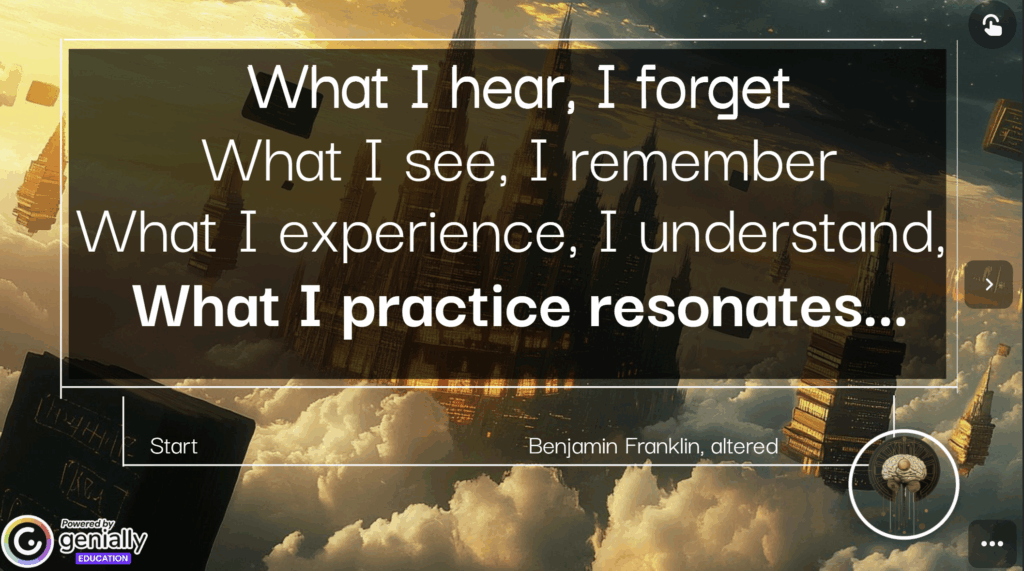
A futuristic university under siege by curriculum gremlins. Alignment is broken. Objectives don’t match assessments. Chaos reigns. Players arrive as visiting professors on a mission: restore order by mastering the six levels of Bloom’s Taxonomy.
The Learning Journey:
Six breakout-style quests, each aligned to a cognitive level:
- Remember: Identify measurable verbs from a collection of notecards
- Understand: Match cognitive levels to corresponding verb lists through drag-and-drop
- Apply: Classify objectives by typing their cognitive level
- Analyze: Sequence objectives in logical teaching order
- Evaluate: Critique colleague work, identifying alignment (or misalignment) between objectives and assessments
- Create: Design assessments that properly align with given objectives
Each level functions as a breakout room—players gather hints and information needed to solve the challenge and advance. This version utilizes Genial.ly’s premium features for narration and tracking, creating an immersive learning experience that teaches instructional design principles through gameplay.
Iteration #2:
From Paid Platform to Conference Workshop: Redesigning for Accessibility
The original game concept was built on Genial.ly’s paid tier, allowing narration uploads and learner tracking. When invited to lead a Bring Your Own Device session at the TechLearn Gamicon Pre-Conference, I saw an opportunity: redesign the game using only free-tier features so attendees could replicate it without subscription barriers.
With the Fall 2025 conference in New Orleans, I reimagined the premise around a Jazz Academy infiltrated by “discord gremlins” who’d disrupted curriculum alignment, objectives, and assessments. Players take on the role of concertmaster, called in to help the academy prepare for an imminent review by a local maestro. The stakes? The school’s prestigious standing hangs in the balance, and time is running out.
After rebuilding the game from scratch, I created step-by-step documentation and video tutorials introducing new users to Genial.ly basics—adding assets, navigation, and foundational features. The conference workshop focused on intermediate skills: animation and interactivity available in the free platform. I’m currently finalizing an advanced workshop covering free add-on components needed to complete the full game experience.
Overview Video (logic of escape game build process)
Engage with the experience (with answers)
Build It Yourself : Google Drive Step-by-step materials (written and video walk through)
- Introductory: Genial.ly basics, asset management, and navigation (step-by-step docs and videos available)
- Intermediate: Animation and interactivity using free-tier features (delivered at conference)
- Advanced: Free add-on components for complete game functionality (in development)